Pastry
School in Paris
An
Adventure in Capacity

Author: Cindy Neuschwander
Illustrator: Bryan Langdo
Recommended Grade Level: 4th-6th
Solve problems involving measurement and conversion of
measurements.
CCSS.Math.Content.4.MD.A.1
Know relative sizes of measurement units within one system of units including km, m, cm; kg, g; lb, oz.; l, ml; hr, min, sec. Within a single system of measurement, express measurements in a larger unit in terms of a smaller unit. Record measurement equivalents in a two-column table. For example, know that 1 ft is 12 times as long as 1 in. Express the length of a 4 ft snake as 48 in. Generate a conversion table for feet and inches listing the number pairs (1, 12), (2, 24), (3, 36), ...
Know relative sizes of measurement units within one system of units including km, m, cm; kg, g; lb, oz.; l, ml; hr, min, sec. Within a single system of measurement, express measurements in a larger unit in terms of a smaller unit. Record measurement equivalents in a two-column table. For example, know that 1 ft is 12 times as long as 1 in. Express the length of a 4 ft snake as 48 in. Generate a conversion table for feet and inches listing the number pairs (1, 12), (2, 24), (3, 36), ...
CCSS.Math.Content.4.MD.A.2
Use the four operations to solve word problems involving distances, intervals of time, liquid volumes, masses of objects, and money, including problems involving simple fractions or decimals, and problems that require expressing measurements given in a larger unit in terms of a smaller unit. Represent measurement quantities using diagrams such as number line diagrams that feature a measurement scale.
Use the four operations to solve word problems involving distances, intervals of time, liquid volumes, masses of objects, and money, including problems involving simple fractions or decimals, and problems that require expressing measurements given in a larger unit in terms of a smaller unit. Represent measurement quantities using diagrams such as number line diagrams that feature a measurement scale.
Summary: While the Zill family is
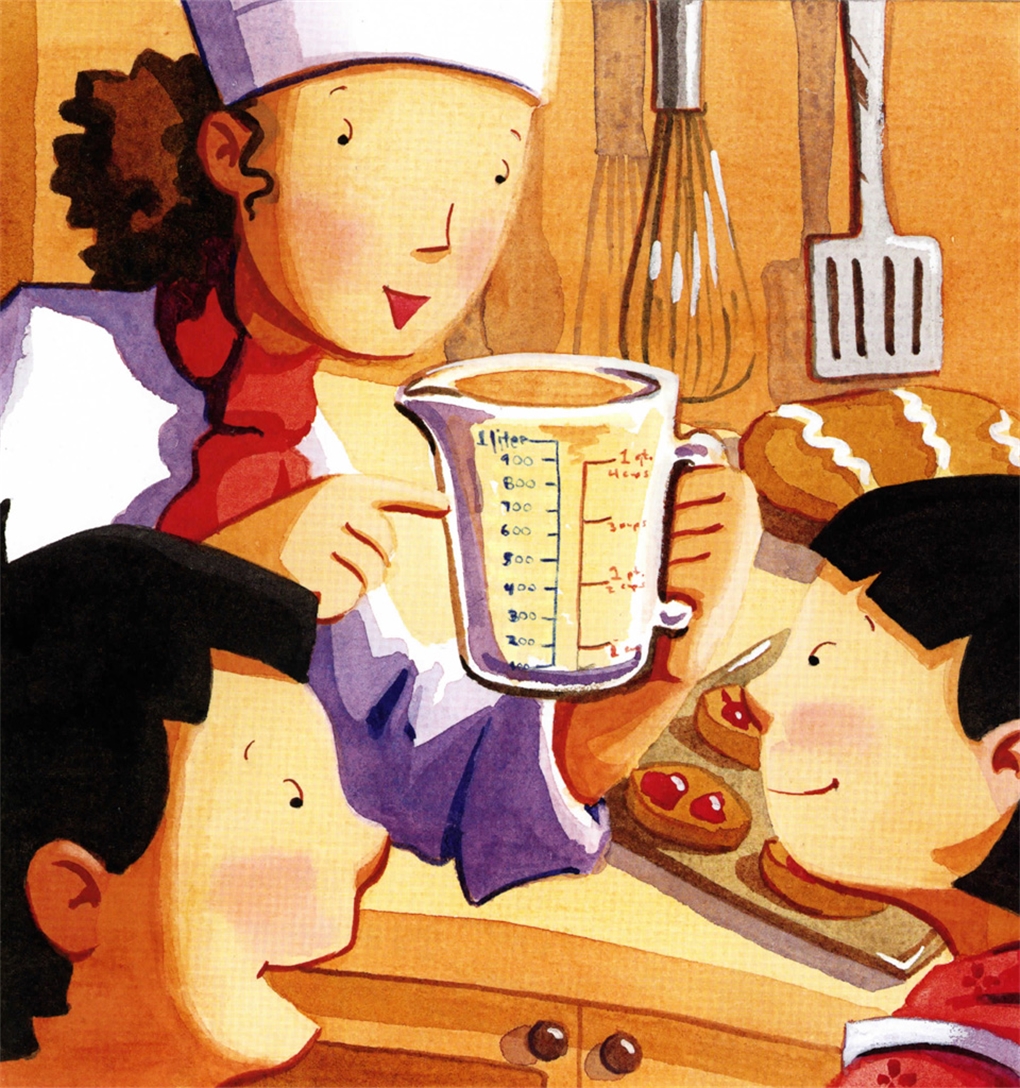
off in Paris, Matt and Bibi take a class at the International Pastry
Academy. Their father had recognized
their cooking talent when they baked brownies at home and he thought it would
be fun for them to learn how to make other tasty desserts while visiting
Paris. In cooking class, they learned
that it is critical to measure ingredients exactly. For cooking with liquids a large, marked
measuring cup is the tool of choice. Most
cups are marked with both parts of quarts (American) and parts of a liter
(French). They also learned by trial and
error that measuring liquids can get confusing and that some measurements have
more than one name. When the Inspector
General comes for an unexpected visit, the twins save the day by cooking and
serving “Ladybugs in the Garden” which was homemade cherry-pepper ice cream
served on a bed of brownies and garnished with mint leaves. “Magnifique! Was the
inspector’s reaction.
Rating (1-5 Stars): ***** I highly recommend this book because it is a delicious adventure in math filling a student’s mind with knowledge of liquid measurements. The illustrations help a student understand mathematical ideas with baking something sweet and chocolatey.
Classroom Ideas/Lesson Ideas:
I would use this lesson to review measurements for capacity. I would introduce a “gallon guy” manipulative which will be constructed by the students prior, to assist in conversions when problem solving. The essential question will be,” what is the relevancy of capacity?” How about the value and price for some store-bought items? Using authentic items, students can locate how many fluid ounces each container holds.
Materials which students
will need: magnifying glass (to look at the labels), measuring cup, bottle of
jelly, syrup, soda, perfume, shampoo, etc.
Students can begin to
learn the cost of each item. The
activies will be a less is more chart to complete by examining the items and
students will draw a picture of the gallon guy to help as a reference. The chart will have a column for item,
customary liquid measure, metric liquid measure, and a guess as to what they
believe the item cost. They find out the
results in the end of the hands-on activity.
Encourage students to read
labels on containers! This will help
them understand how much liquid various bottles and containers actually hold.


This book seems like an appropriate context for teaching young students the mathematical concept of measurement in regards to the CCS. I liked the story line of the book and even think that it might be interesting to double it as a home economics lesson plan, such as having the kids have a cooking lesson to keep in theme with the book and reinforce the value of measurement. Plus, everybody eats so that should keep the students engaged.
ReplyDeleteThank you Roxanne ! I like your other lesson idea about economics. I just thought how I could somehow bring cultures into the lesson too even though it's a math lesson !! Maybe I could ask them to bring in a special family recipe so we can see the different amount of ingriedients their families use and learn a little more about them.
ReplyDelete